
It is known as evolution mechanisms several processes through which evolutionary change occurs, because they cause changes in the frequencies of genes of individuals in populations.

Natural selection
It is the best known mechanism of all and the one that Charles Darwin described to explain his theory of evolution in the nineteenth century. According to Darwin, individuals in a population with variability, who are better adapted to their environment, are more likely to survive, reproduce and have offspring. It naturally inherits the genes of its parents as well as the traits that characterized them. Conversely, individuals who do not adapt to the environment are less likely to survive, reproduce and transmit their genes.

Genetic drift
To understand this, it is necessary to know that an allele is one of the alternative forms that a single gene may have; for example, the gene that determines the color of a person's eyes may have an allele for the brown color and an allele for the blue color. An allele is recessive if it is present on both chromosomes of a pair, but dominant if it is found on one or both chromosomes of a pair. The first allele is dominant and the second is recessive. If a person inherits one or two alleles for the color of blue eyes, they will have blue eyes, but can only have brown eyes if they inherit two copies of the allele for brown eyes.
Imagine that a group of 50 dark-skinned settlers arrive on a small, isolated island and settle thriving there. Colonists' descendants will have most of the characteristics of their ancestors, and the population will have little genetic variability. This does not imply adaptation to their environment, nor competition with other individuals, since hypothetically people do not arrive from other parts of the world. So, the population tends to have dark skin due to genetic drift.
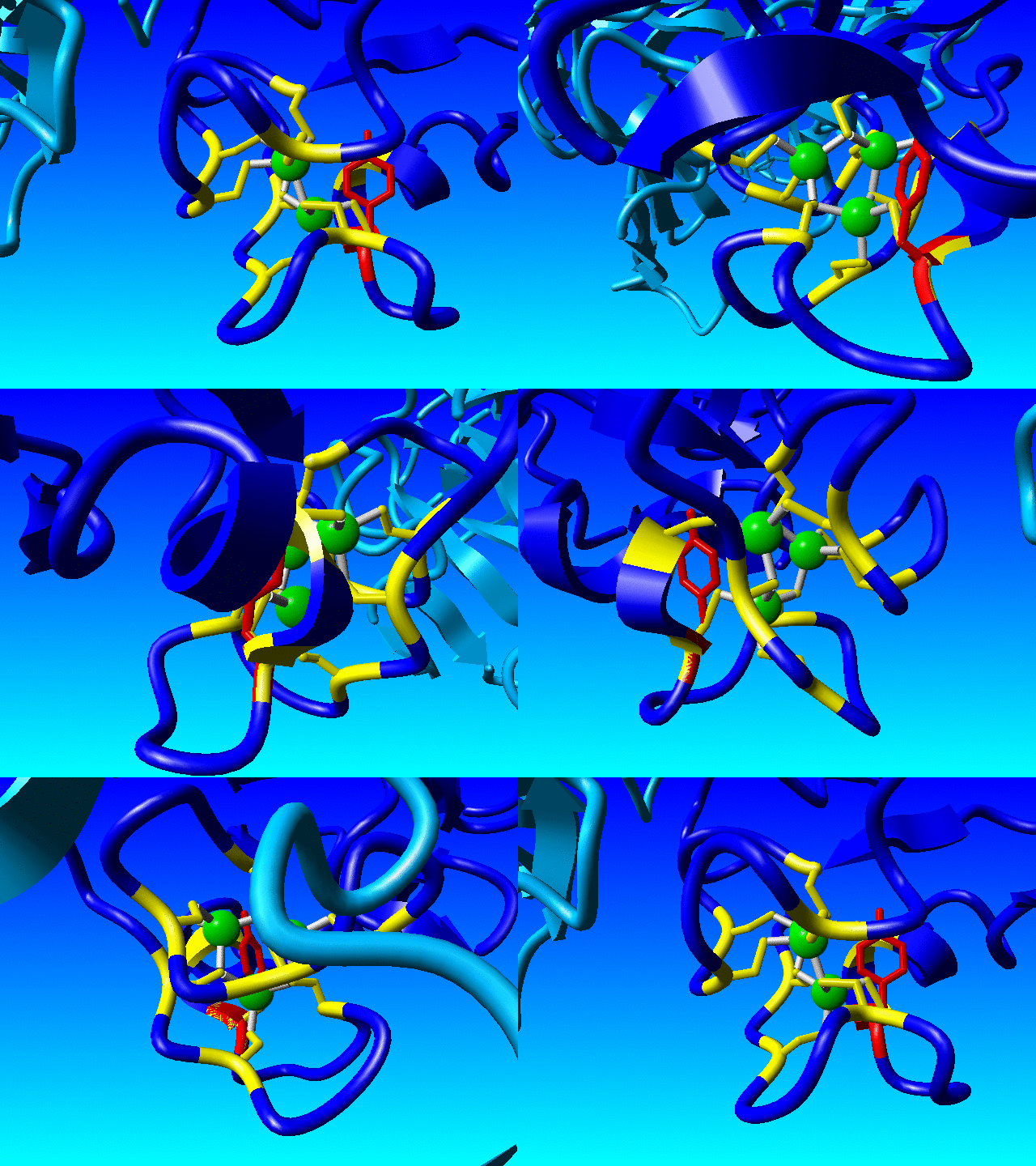
They are permanent changes in genetic material that are visible when descendants of individuals have different characteristics from their parents. The causes of mutations are related to errors during cell division (reproduction) and contact with chemical agents and radiation.

It is also known as "gene flow" and consists of transferring genes from one population to another. In this case, individuals from one population may move to another region with a population and reproduce with individuals from that population, resulting in a change in allele frequencies and new genetic variants in the population.
https://www.youtube.com/watch?v=-mPCqYxB4d4