So far, I have treated carbonyl compounds together and looked at reactions of the C=O functional group in both aldehydes and ketones. They do, however, differ in their reactions with oxidising and reducing agents. Therefore, I will now look at reactions of the aldehyde functional group separately from those of the ketone functional group.
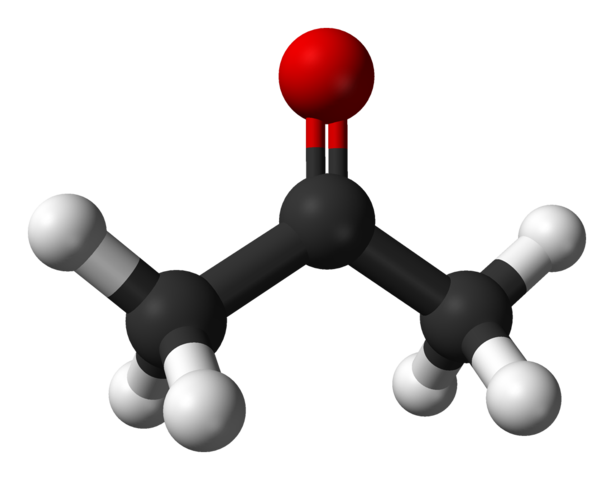
REDUCTION OF ALDEHYDES AND KETONES
With a reducing agent, such as NaBH4
or LiAlH4 aldehydes give primary alcohols and ketones give secondary
alcohols. Notice that the reducing H in
the equation is in brackets (to balance the equation simply – it does not
represent atomic hydrogen). The reaction is not that simple, as you can see
from its mechanism in my previous post. The reduction reactions of aldehydes
and ketones are essentially the reverse of the oxidation reactions of primary
and secondary alcohols.
OXIDATION OF ALDEHYDES
Aldehydes are prepared by oxidising primary
alcohols, and ketones by oxidising secondary alcohols. In the case of primary
alcohols, if the aldehyde is not removed from the oxidising agent immediately
it is formed, it is further oxidised to give the carboxylic acid. The aldehyde
is removed from the reacting mixture by distillation. Primary alcohols are
usually mixed with acidified potassium dichromate and the aldehyde distilled
off as soon as it is formed to prevent further oxidation. If the primary
alcohol is refluxed with K2Cr2O7(aq)/(H+(aq)),
then a carboxylic acid results.
Ketones resist further oxidation, because they
have no oxidisable hydrogen bonded to the carbonyl group. However, with
prolonged heating they can be oxidised by strong oxidising agents. By contrast,
the oxidation of aldehydes occurs even in air, so that bottles of opened
aldehydes soon contain amounts of carboxylic acids. This difference in the
reactivities of aldehydes and ketones to oxidation is one of the main reasons
they are considered as separate classes of compounds. It also provides an ideal
way to distinguish between them.
Oxidation of aldehydes by acidified potassium dichromate(VI)
When an acidified solution of the orange
dichromate(VI) ion is warmed with an aldehyde, it is reduced to the green
chromium(III) ion. In this reaction the aldehyde is ethanal.
Oxidation of aldehydes by Fehling’s and Benedict’s solutions
Either or both of these reagents may be used
in your chemistry course. They are alkaline solutions that contain copper(II)
as complex ions, so the colour of both is blue. The copper(II) ions act as a mild
oxidising agent. When the reagent is mixed with an aldehyde and heated, the
aldehyde is oxidised to give a carboxylic acid, while the copper(II) ions are
reduced to a brick-red precipitate of copper(I) oxide, Cu2O. A
balanced equation for this reaction is:
RCHO + 2Cu²+(aq)
+ 2H2O → RCOOH + Cu2O(s) + 4H+(aq)
This reaction can be used to distinguish between an aldehyde and a ketone. While this reaction is less used now that we have spectrometers, it is still an important test in some situations, such as diagnosing diabetes.
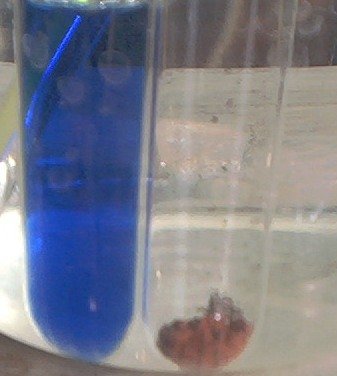
Fehling reaction. FK1954, Public Domain
Tollens’ reagent and the oxidation of aldehydes
Tollens’ reagent provides yet another way to
test for aldehydes. This time, the oxidising agent is a complex of silver(I)
ions, which are reduced to silver in the test. There is a figure of a silver
coating the inside of a test tube, making a ‘silver mirror. The complex, which
has the formula [Ag(NH3)2]+, is made by mixing
together aqueous solutions of ammonia and silver nitrate. The resulting solution
is called Tollens’ reagent, or ammoniacal silver nitrate. When warmed with an
aldehyde, it produces the ‘silver mirror’.
This is a simplified balanced equation for the
reaction:
RCHO + 2Ag+(aq)
+ H2O → RCOOH + 2Ag(s) + 2H+
The reaction provides one of the ways in which
mirrors are silvered.
SUGARS
Glucose gives a positive test with both
Fehling’s and Benedict’s solutions. As it has this reducing property, glucose
is known as a reducing sugar. In one of its forms, glucose contains an aldehyde
group, which accounts for this property. Diabetes is easily diagnosed using
Benedict’s or Fehling’s reagent, which detects glucose in urine samples; and
Benedict’s reagent in tablet form, or impregnated into a strip of paper, is
used by diabetics to monitor their blood sugar levels.
Alcoholic drinks and the formation of aldehydes
When you have an alcoholic drink, ethanol
passes into your bloodstream. The liver has to break down the ethanol. In the first
stage, it is oxidised to ethanal. Ethanal is then oxidised into other products.
However, if you drink a lot of ethanol in a short space of time, the ethanal
that enters the bloodstream is distributed throughout the body. Your face goes
red, you may feel an unpleasant tingling in the limbs and nausea, and your
blood pressure may drop.
Methanol is added to ethanol that is intended
for other uses, to make it unfit for drinking. This mixture is commonly known
as methylated spirits (meths). Once inside the body, methanol is oxidised into
an aldehyde, which rapidly causes liver damage and blindness. So,
unfortunately, if people are determined to drink meths they are risking their
lives.
TRI-IODOMETHANE TEST
This is a useful test for the CH3CO
group in carbonyl compounds. An alkaline solution of aqueous iodine is warmed
with the substance suspected to contain this group. Iodine has a very low solubility
in water. Therefore, the aqueous solution is made up by dissolving it in KI
solution. If a yellow precipitate of tri-iodomethane is produced, it is highly
likely that CH3CO is present.
As I2(aq)/NaOH(aq) is an oxidising agent, the tri-iodomethane test also gives a positive result with alcohols that contain the CH3CH(OH) group.

Ball and stick model of iodoform. Ben Mills, Public Domain
SUMMARY
After studying this post and the previous one,
you should know the following:
- The carbonyl group C=O is found in both aldehydes (RCHO) and ketones (RCOR’), so they are called carbonyl compounds.
- The polar nature of the carbon-oxygen double bond in the carbonyl group makes it susceptible to nucleophilic addition reactions. This contrasts with the electrophilic addition reactions of the alkene carbon-carbon double bond.
- 2,4-dinitrophenylhydrazine gives characteristic orange precipitates with carbonyl compounds. The resulting 2,4-dinitrophenylhydrazone derivatives can be used to identify specific aldehydes and ketones from their precise melting points.
- Both aldehydes and ketones undergo nucleophilic addition reactions with HCN and with H- ions (from, for example, NaBH4).
- Aldehydes (but not ketones) are oxidised to give carboxylic acids by mild oxidising agents, such as Cr2O72-/H+, alkaline solutions of Cu2+ (Fehling’s solution) and Ag+ (Tollens’ reagent). These reactions can be used to distinguish between aldehydes and ketones.
- Alkaline aqueous iodine gives tri-iodomethane (CHI3) with CH3CO compounds, and also with alcohols that contain CH3CH(OH).
Thanks for reading.
REFERENCES
http://www.differencebetween.net/science/difference-between-aldehydes-and-ketones/
https://en.wikipedia.org/wiki/Carbonyl_reduction
https://www.chemguide.co.uk/organicprops/carbonyls/reduction.html
http://www.chem.ucalgary.ca/courses/351/Carey5th/Ch15/ch15-2-6.html
http://www.chem.ucalgary.ca/courses/351/Carey5th/Ch17/ch17-3-5-1.html
https://www.chemguide.co.uk/organicprops/alcohols/oxidation.html
https://www.toppr.com/guides/chemistry/aldehydes-ketones-and-carboxylic-acids/oxidation/
https://www.embibe.com/study/oxidation-of-aldehydes-and-ketones-with-benedict-s-solution-concept
https://www.chemguide.co.uk/organicprops/carbonyls/oxidation.html
https://www.youtube.com/watch?v=_0TqG8-N8DI
https://www.chemguide.co.uk/organicprops/carbonyls/oxidation.html
https://www.hindawi.com/journals/ijac/2011/797604/
https://www.ncbi.nlm.nih.gov/pmc/articles/PMC2872347/
https://www.ncbi.nlm.nih.gov/pmc/articles/PMC4693266/
https://en.wikipedia.org/wiki/Iodoform
https://chemistryguru.com.sg/triiodomethane-or-iodoform-test