Friends of Steemit, today I want to talk about a really interesting topic, which is part of the latest advances in terms of medical treatments, we live in the genomic era, where genetic engineering and biotechnology are the order of the day, progress in medicine take a giant steps and today I want to tell you about one of those advances: gene therapy.

Some visionary scientists proposed that genetic modification could be an effective treatment for many diseases of monogenic origin (mutation or alteration in a single gene). Nowadays it’s considered a promising therapeutic option for a great variety of diseases.
Genes are the basis of our inheritance, pass from parents to children and contain the necessary information to make proteins.
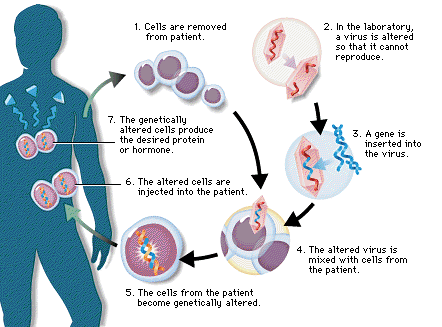
The most common form of gene therapy is to introduce a normal gene to replace the abnormal gene. This genetic material is introduced into the cell through a carrier known as a "vector". The most commonly used vectors are viruses modified in the laboratory (to make them safer). The "target" cell becomes infected with the vector and thus it discharges its genetic material (containing the therapeutic gene) into the cell, restoring the normal functioning of the cell. There are non-viral methods such as the application of naked DNA, the use of oligonucleotides or the creation of artificial chromosomes.
The following approaches are those that until now have had the best results in gene therapy:

The "in vivo" administration of vectors to introduce therapeutic genes into human cells.
"Ex vivo" therapy, in which the transformation takes place outside the organism and then the transformed cells are transplanted to the patient. An example is the administration of patient hematopoietic stem cells, which were modified in a laboratory to be injected again into the patient.
History of Gene Therapy
It has been a long road. The first tests were in the 70s but they failed. In the 80s it began to be successful with experimental animals but could not be used in humans.

In the years 2.006 and 2.007, a benefit was obtained in the treatment of pathologies such as metastatic melanoma, hemophilia, HIV and certain types of amaurosis (blindness). In 2012, the European Commission authorizes the use of gene therapy for the treatment of lipoprotein lipase deficiency.

In recent years, the "genome edition" approach has been developed, so that not only genes can be added (as in technology with vectors) but also gene ablation and genetic "correction" can be performed. It is expected that clinical trials of genome editing will begin in the next decade.
Obstacles of gene therapy
This type of therapy has faced many obstacles, among which I will mention:
- In many cases it does not involve the cure of the disease, for which reason the therapy must be repeated every so often.
- It can provoke an immune response of the organism (to a foreign agent such as a virus or genetic material), this response being greater with each application.
- Problems related to viral vectors that can generate some type of disease.
- Application in diseases whose origin is the alteration of several genes.
- Risk of inducing a tumor as a result of the mutation.
Ethical implications in gene therapy

Although the change of "unwanted" traits can certainly improve the quality of life of the individual, some fear that it may promote greater discrimination against those who retain the "undesirable traits" and this not only covers the physical field (beauty, prolongation of the life), but also the mental or psychological (intelligence). The fear that this type of treatment will focus on "genetic improvement" has caused numerous debates (with the participation of politicians, scientists and even representatives of different religions) and should lead to the establishment of ethical guidelines governing their use.

I conclude the post remembering that almost 50 years have passed since gene therapy was proposed for the first time and although it has been a long way, full of ups and downs I am very optimistic with this type of therapy and I hope continue efforts to make it soon part of the therapeutic arsenal, there is still much to learn ...
Data of the review taken from:
- http://science.sciencemag.org/content/359/6372/eaan4672
- https://www.eurekalert.org/pub_releases/2018-01/nhla-mat011118.php
- http://www.genetherapynet.com/patient-information.html
- http://www.genetherapynet.com/what-is-gene-therapy.html
- https://en.wikipedia.org/wiki/Gene_therapy
- https://medlineplus.gov/genesandgenetherapy.html
- https://scielo.conicyt.cl/scielo.php?script=sci_arttext&pid=S1726-569X2003000100007
