Cost Pyramid
As the Iran War enters its 3rd week with no end in sight, I thought I might want to share some of my personal thoughts. First of all, I was in Europe travelling, and that set of posts will arrive soon, but also rather busy with work related to Middle East as I actively work there. Instead getting into the politics of the recent Iran war, let us for a second focus on the cost structure.
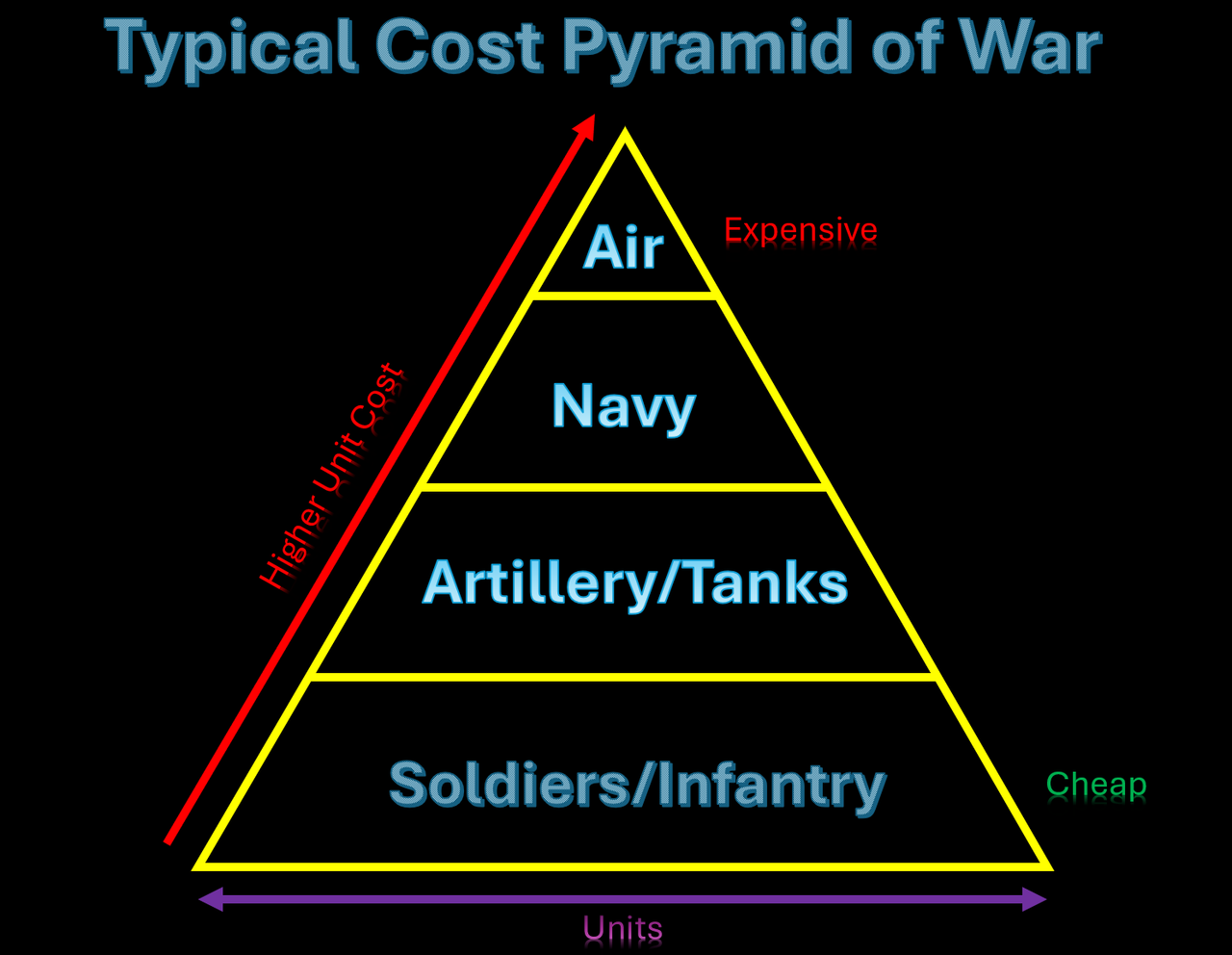
A typical military have the above cost structure. You can thing about it as a triangle or pyramid. Please bear with me here, as I will be very blunt and analytical, without thinking about the human emotional perspective. At the base of the pyramid or triangle are the Soldiers. They are the cheapest, and the United states can get them in volumes at very little cost. They are followed by Artillery, Tanks and other armored units. They can cost higher, but still US can and did produced them in high volume. That is followed by Navy, and in turn followed by Air Force and Missiles, which cost the highest to produce and therefore US, and every other military has the least of them.
For a typical military operation to succeed, it is therefore, cost effective to have boots on the ground. That's the conventional way of basic warfare. Yes, the loss of human life will be a lot, but humans cost very little compared to a missile or an airplane. I know several of you are cringing, believe me, I am too, but this is the reality. This is in fact explained very nicely in the History of the Peloponnesian War by Thucydides. It was written 431 B.C.E, and obviously it is free to read! I can tell you it is an exceptionally good read!
https://classics.mit.edu/Thucydides/pelopwar.html
History of the Peloponnesian War is an account of the long conflict (431–404 BCE) between Athens and its empire and Sparta and the Peloponnesian League. Thucydides, an Athenian general and contemporary of the war, presents the struggle not as a heroic epic but as a systematic study of power, fear, ambition, and human behavior under pressure. His goal is to create a work that explains how and why wars happen, not merely to record events.
I can write volumes on this book, but I like to focus on the Sicilian Expedition (415–413 BCE). The central tragedy of the work is Athens’ disastrous invasion of Sicily:
- Promoted by ambitious leaders, the expedition aims to conquer Syracuse and expand Athenian power.
- Despite warnings, Athens commits massive resources far from home.
- The campaign ends in total defeat: the fleet is destroyed, the army is trapped, and thousands are killed or enslaved.
Thucydides presents this failure as the result of overconfidence, poor leadership, and the inability of democratic assemblies to resist seductive but unrealistic plans.
Do you see any similarities with the Iranian War today? No, I am not saying, this war will be lost for the United States, no, but the parallels are uncanny. Hopefully, this is modern times and other variables will become more important.
Strategic Overreach Is an Asymmetric Vulnerability
Athens was the dominant power—naval superiority, wealth, experience. Sicily was distant, unfamiliar, and politically fragmented. The expedition assumed that Athenian strength alone would compensate for geography, logistics, and local politics. Superior powers expose themselves when they project force far from core bases. Distance favors weaker actors who can stretch supply lines, exploit local delays, and wait for mistakes.
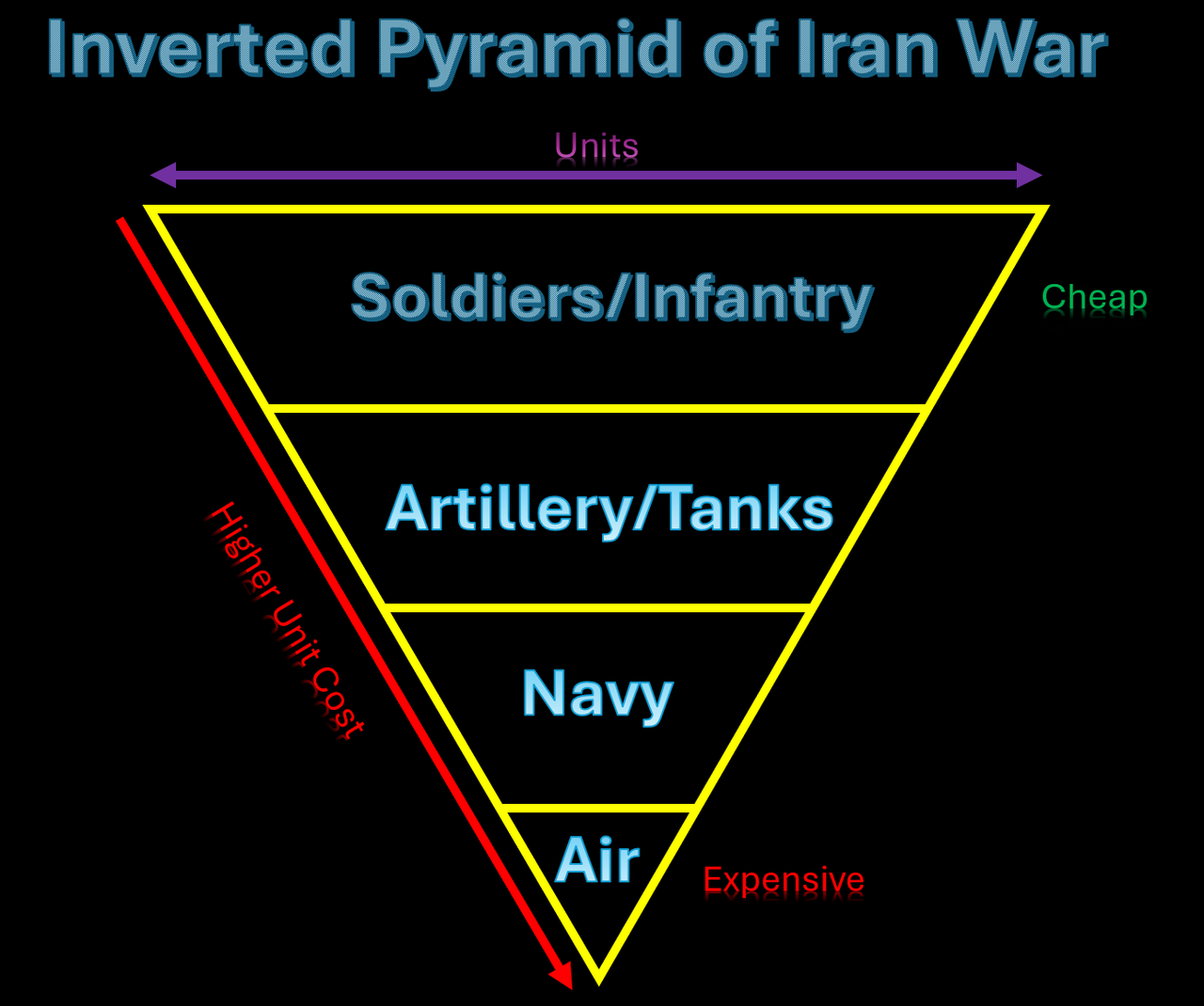
If you look at the figure above, that summarizes the US strategy in the Iranian war. Missile defense and attack systems are asymmetrically expensive. I am sure you are aware, that these are now common knowledge:
- Iranian Drone Costs: Shahed-136: ~$20,000 – $50,000.
- Kamikaze Drones (general): ~$30,000 – $35,000.
Interceptor Missile Costs:
- Patriot (PAC-3 MSE): ~$3 million – $5 million per missile.
- Standard Missile-2 (SM-2): ~$2.1 million per shot.
- THAAD: ~$13 million per interceptor.
A single Patriot PAC-3 MSE missile costs approximately $4 million (based on FY2022 data), with export costs often ranging between $6 million and $10 million per unit. A full Patriot battery (including radars, control station, and launchers) can exceed $1 billion. During the early days of the war, US and/or their Middle East allies fired as many as 10 Patriot missiles to intercept a single Iranian Shahed Drone (running on a 50 CC moped engine!). If this is not the asymmetric warfare, I don't know what is! Iran is running a 100:1 or higher cost advantage over USA.
What is the End-Game?
First of all, is there any? Second, even if there will be boots on the ground at some near or distant future, the past experience is not great. Syracuse and his allies understood terrain, politics, and timing far better than the Athenians. Athens relied on general assumptions about “Greek cities” rather than specific Sicilian realities. Local actors rarely need to match your strength—they only need to understand you better than you understand them. That is how asymmetric warfare works, and there are plenty of modern examples....Vietnam, Iraq, Afghanistan ...
The nearest Port in the Persian Gulf where infantry can land is Bandar Abbas at the strait of Hormuz. Tehran is 1300 KM by roads over highly inhospitable terrain from there. Yes, there is alternate access from Basrah from Iraq which cuts down the distance by half, but you must cross the Zagros Mountains! There is no access from the West, North or East. So you are stuck between rock and a hard place.
Thucydides presents Athens’ assembly as emotionally volatile, initial enthusiasm drove escalation, while fear later drove rash decisions. Leaders competed for popularity rather than coherence. Athens stayed in Sicily long after success was unlikely because withdrawal risked humiliation and loss of imperial credibility. Do you see any parallel?